


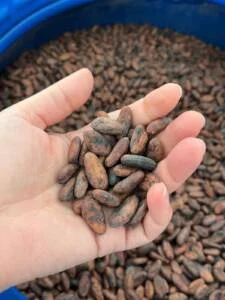
Before making cacao mass—roasted cacao beans must be cracked and the shells separated from the cacao nibs.
This step is called cacao winnowing. The shells can be removed by hand or with a machine called a cacao winnower.
Unfortunately, there’s a growing narrative—particularly within parts of the ceremonial cacao community—that cacao whose shells were removed by hand is somehow of higher quality.
It isn’t.
What Is Cacao Winnowing?
Once cacao beans have been roasted, they become brittle enough for the outer shell to separate from the bean. The beans are cracked into smaller pieces, creating a mixture of cacao nibs and lightweight shell fragments.
The purpose of cacao winnowing is simple: remove the shells while preserving as many of the valuable nibs as possible.
A cacao winnower uses carefully controlled airflow to separate the lighter shells from the heavier nibs. The principle is straightforward: the shells are lighter, the nibs are heavier.
Finding the correct airflow is where experience matters. Too little air leaves shell behind; too much carries valuable nibs away with the husks. Every bean origin, roast profile, and bean size requires slightly different adjustments to achieve an efficient separation.
In other words, a winnower isn’t a shortcut. It’s simply an efficient sorting machine.
Is Hand Winnowing Better?
This is where marketing often replaces science.
Could every shell be removed by hand?
Of course.
You could also peel potatoes with your fingernails.
The question isn’t whether it can be done. The question is whether it produces a better product.
The answer is no.
Removing shells by hand doesn’t improve flavour, texture, purity, or quality. It simply replaces an efficient sorting process with manual labour.
The Economics Behind Hand-Peeled Cacao
Here’s the part that rarely appears in the marketing.
If you wanted to remove cacao shells by hand in Denmark, you’d be paying Danish wages for a slow, repetitive task that adds nothing to the finished cacao.
Instead, this work is typically carried out in countries where wages are significantly lower.
That raises an uncomfortable question.
When brands advertise “hand-peeled” cacao as a premium feature, are they highlighting superior craftsmanship—or are they turning inexpensive manual labour into a luxury marketing story?
There is nothing inherently noble about replacing an efficient process with repetitive manual work simply because that work is inexpensive in another part of the world.
Good Cacao Is About Better Decisions—Not More Labour
Bean selection.
Fermentation.
Drying.
Roasting.
These processes all have a profound impact on flavour and quality.
Whether the shells were removed by a skilled winnower or by someone’s fingers does not.
Producing exceptional cacao—and maintaining a genuine connection to its origin—isn’t about rejecting technology. It’s about understanding which processes improve quality, which tools improve consistency, and which stories exist primarily to sell a product.